

“WE PROTECT US,” one of many slogans people turned to as they flooded the streets in the summer of 2020, reappeared this summer with new urgency: In Los Angeles, amid protests—call it community defense—against ICE, and in dispatches announcing four detainees’ escape from a Newark, New Jersey, immigration detention center. Like any good political slogan, it points toward a different way of living, without the threat of racist police violence, and without the threat of state-enforced disappearing operations (tall orders, apparently). But it’s also a reminder that we protect each other all the time. In the context of the protest, we do so most immediately by existing among others: Combined, we create a crowd the police can’t easily disperse. More broadly, “WE PROTECT US” also applies to the many everyday acts that make up a community, whether we’re crowdfunding to pay someone’s medical bills, taking care of our neighbor’s kids for the afternoon, petitioning our landlord to fix the heating, or shouting “la migra” for others to heed. The nineteenth-century anarchist Pyotr Kropotkin labeled practices such as these mutual aid, an evolutionary practice across species, which, in his view, indicated a cooperative ethos that undermined the Darwinian principle of competition.
In her new book, Making Precarity Work: Life on the Edge of Venice Beach, Laura Orrico, a sociologist at Temple University and former longtime L.A. resident, has termed it the “subversive safety net.” Different terms for different times, perhaps. While the “official” safety net—those blandly named, life-sustaining government programs such as the Supplemental Nutrition Assistance Program, or SNAP, formerly known as food stamps; Medicare and Medicaid; and so on—offers crucial support for millions of Americans, the budget cuts, bureaucratic barriers, and eligibility requirements that have multiplied since the 1970s (and stand to deepen under Trump) eroded its ability to function effectively. As a result, the “subversive safety net” picks up the slack.
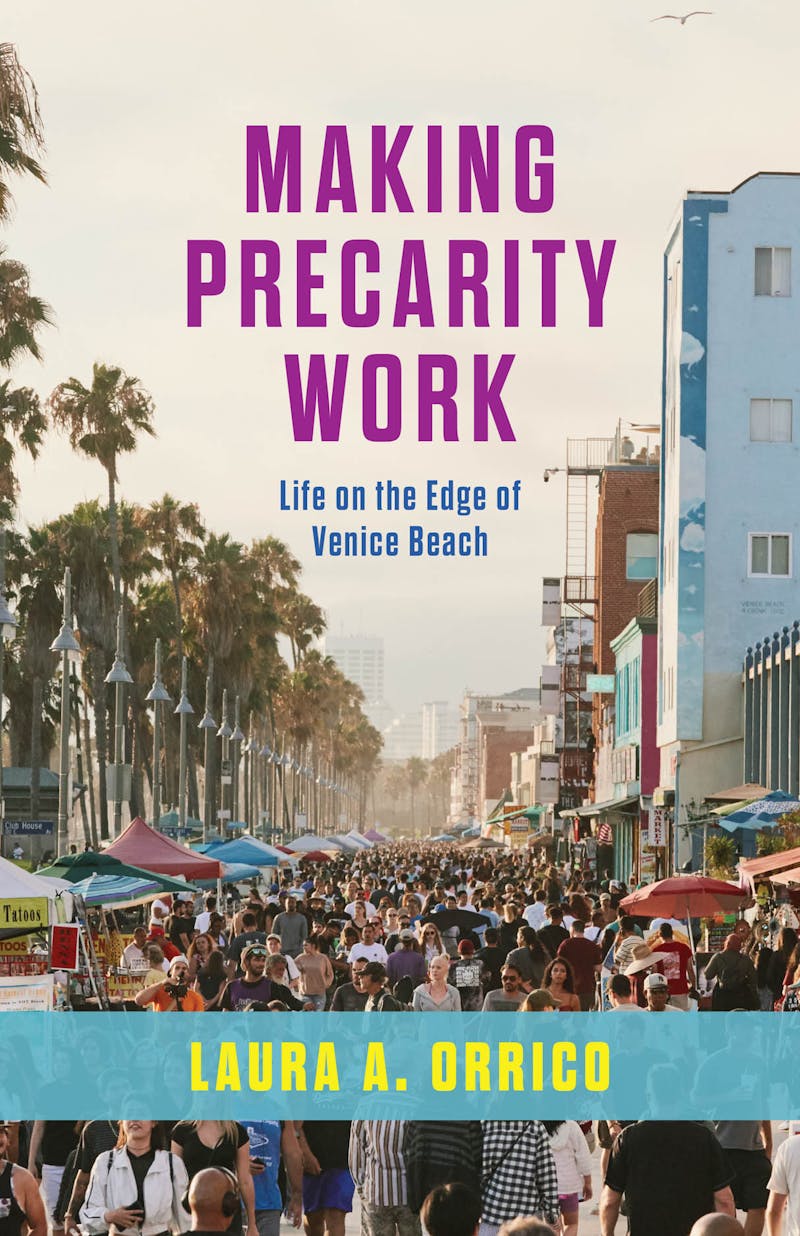
Making Precarity Work: Life on the Edge of Venice Beach
by Laura A. Orrico
University of Chicago Press, 208 pp., $27.50
To Orrico, this process is an imperfect replacement shaped by people’s needs “through an ongoing dialogue between individuals and the state.” Making Precarity Work carefully outlines this concept as it exists among the many vendors and drifters who earn their keep on the Venice Beach boardwalk, selling art and merchandise to tourists within a specially allotted, dystopically named “Free Speech Zone.” In some ways, the subversive safety net points to that same “something new” implicit in protesters’ chants against the police. Yet, the one that Orrico observes also has major limitations. “My interests lie in understanding the boardwalk marketplace as a collective accomplishment,” she writes, but that accomplishment has a double edge.
Orrico’s work coincides with a larger trend among American scholars examining the pronounced domestic increase in the “informal economy.” Whereas in the mid-twentieth century, developed countries at the height of their power presumed their own exceptionalism—relegating talk of “slums” to what’s called the Third World—today’s researchers are looking to highlight similarities between the two in an effort to understand policymakers’ role in addressing, or in some cases compounding, the problems in people’s lives. Setting aside the broad economic inequities between, say, New York City and Lima, Peru, tenants in either city will be quick to tell you of their experiences navigating their respective legal regimes—both capable only of irregular enforcement, and often willfully indifferent to living conditions among the poor. The theoretical basis separating government pressures and community dynamics among squatters in Bangalore or Cairo is only degrees away, the thinking goes, from those within Los Angeles tent encampments or overpacked apartments in Queens.
For many scholars, including Orrico, the reduction of “formal” employment options, alongside the erosion of the welfare state, turned street vending of various kinds into a necessary alternative to make ends meet. It’s a familiar story: The post-World War II economy’s “rather secure contract between labor and capital” offered a broad range of wage work under a standardized, “Fordist” manufacturing model, but as the supply chain globalized, capitalists found it cheaper to take factory work abroad, too. “It is likely that Fordism was the anomaly and not the other way around,” Orrico rightly asserts; precarity was and still is the norm outside the West, and before World War II, America’s “secure contract” between labor and capital did not exist. In any case, life in the Goldilocks zone could not last: The late twentieth century was marked by the “flexibilization” of employment, and as a result, millions of workers now lack insurance or retirement plans that had once been commonplace. The harsh characteristics of this neoliberal economy led the economist Guy Standing to argue, in 2011, that a “new” class had formed—the precariat.
Venice Beach makes for a decent case study. Similar to New York City’s East Village and San Francisco’s North Beach, it existed during the postwar years in a state of urban decay. Intentionally conceived as separate from the city of Los Angeles—much like neighboring Santa Monica today—it was once a playground for the rich, adorned with canals, gondolas, and arcaded architecture like its Italian counterpart. After its millionaire founder, Abbot Kinney, died in 1920 and its amusement pier went up in flames (literally) weeks later, Venice fell on hard times and, in 1925, sought annexation into the city of Los Angeles for financial support. With decay, however, came low rents, and thus, a “setting ripe with the possibility to live an alternative lifestyle.” Venice, which had a sizable Black working-class population, became a Beat Generation haunt (Jack Kerouac called Venice the “end of the line”), which, in the ’60s, gave way to the hippie movement; in the ’70s, the surf-and-skate crowd christened the neighborhood “Dogtown,” and in the early ’80s, Arnold Schwarzenegger and his acolytes mainstreamed “Muscle Beach.”
But possibility for some meant displacement for others. Venice’s heritage of free expression was slowly commodified, and with increased commercial viability in the ’80s and ’90s came an increased policing of public space. Black and brown residents of “L.A.’s most visible black locale along the coast” were priced out in droves, while the police cracked down on what the media alternately described as a “gang war” and “race war.”
Orrico describes the boardwalk as a place where the “geography of poverty meets with an ethic of bohemia,” an expression that rings somewhat more platonically than the reality, but it is how many neighborhood residents conceive of it. Even as the city began regulating the “ephemeral worksite” more formally, it remains, for some, an enclave for free expression—hippiedom encased in amber. Orrico notes how vendors play into that heritage, selling dream catchers and peace sign merchandise, harkening back to the “flower children” of yesteryear.
The patina of “peace and love” belies the fact that Venice remains a highly policed public space, where “the rules of the game continued to change” for those on the margins, Orrico writes. Even when then-California Governor Jerry Brown ended the criminalization of sidewalk vending in 2018, the municipal government continued to “control access” to a space that had been more or less open to all for decades prior. In the 2010s, the Los Angeles Police Department administered a lottery system for boardwalk vendors, assigning 205 “designated spaces” through the luck of the draw—one plastic ID card per person. With their livelihoods threatened, vendors turned this into a numbers game, allying with and sometimes outright employing other vendors and even unhoused people to create a statistical advantage. In 2015, the state was forced by a class-action lawsuit to adopt a first-come, first-served approach instead. From then on, spacing on the boardwalk became more routinized, determined by the vendors themselves. People bonded with those on their “block,” and being a “regular” was a plus. With the relative stability this system offered grew deeper forms of collective care, but vendors also closed ranks, denying space and care to others. “Safety nets are rarely equitable,” Orrico concludes, “and this subversive safety net was no different.” Those unhoused workers who vendors employed were just as often discarded.
Making Precarity Work conceives of the subversive safety net as both an opportunity and a warning: The tools we use to protect ourselves might also entrench the same inequities that kill us. Orrico contends that the structure of the Venice Beach community is “a critique of the kind of society that pressures people to produce ‘work’ to meet their needs,” but she identifies something positive in how vendors conceive of themselves. Anyone familiar with Uber’s sales pitch may find uncomfortable similarities between the “entrepreneurialism” expressed by some vendors and those who enjoy “making their own hours” on the road, but there’s a kernel of truth to both. One’s sense of autonomy tends to exist beyond the bounds of the workplace, and here, there isn’t one person vendors can point to and call “boss.” In contrast to sociologist Forrest Stuart’s well-known study on L.A.’s Skid Row—whereupon one’s arrival signified hitting “rock bottom” among the unhoused folks who lived there—Orrico gives us Khaled, a Black vendor, also unhoused, reclining in his chair on Venice Beach, who all but shrugs when asked about policing and new city regulations. “They just don’t want to see a Black man at the beach with his feet up,” he said.
In fact, part of what made Venice Beach home for so many people was their ability to communicate about—and often outsmart—the police. Where the boardwalk’s “Free Speech Zone” stipulated that only certain kinds of products (such as peace signs and other, frankly dated forms of “public expression”) were “protected” by the First Amendment, vendors sometimes skirted the rules to make ends meet, and tipped each other off when the police were coming. (One unhoused vendor made national headlines when he began to sell cardboard “bum signs,” offering tourists the chance to snap pictures posing as unhoused themselves.) More than that, vendors watched each other’s kids, ate meals as a community, entrusted their belongings (including cash) to others, and shared vehicles with friends so they had a safe place to sleep. The subversive safety net was, in a sense, often at odds with the law, but it was also vital to avoid destitution, fines, even imprisonment. The greatest risk to vendors came when new cops were assigned to the beat; what one officer had overlooked might suddenly become an arrestable offense.
In her 2019 book-length survey of the world’s housing regimes, former United Nations rapporteur Raquel Rolnik points out that the “dominant narrative” surrounding informal spaces like Venice Beach as “resulting from the absence of the state” is, for the most part, misleading. After all, policing is expensive, and even with all those tax dollars siphoned from welfare programs into police budgets, holding territory today is less the objective, writes Johns Hopkins historian Stuart Schrader, than is “the protocol of the lightning raid”—fast, small, hit-and-run operations that reduce cost, and risk, for municipal departments, “leaving the populace to manage itself and coordinate its survival via the cold cash-app nexus.” Where informality might seem like the reduction of state capacity, Rolnik writes, these spaces are in fact “strongly constituted and permanently mediated by the state.” Grating against Orrico’s view that Venice Beach has not undergone a process of “formalization”—e.g., a more rigorous permitting or “review” process for artists, personal identification, and so on—Rolnik shows that “indetermination” is beneficial to local governments and real estate interests, as they wait for the “right time” to swoop in.
And swoop in they have. As Orrico notes, Venice Beach today is sometimes referred to by a new moniker: Silicon Beach—it’s now home to dozens of tech companies, including Snapchat, responsible for a new wave of displacement. In 2021, the Los Angeles Times reported how, with the help of the police and park rangers, the city had “finally” forced roughly 200 unhoused people off the beach. As part of the city’s notorious “Project Roomkey” (nicknamed “Project No Key” among the unhoused), a few were placed in apartments, and the rest were sent to prison-like temporary rooms in hotels or congregate shelters. Most recently, the city has repeatedly stalled the construction of 120 permanent homes for unhoused people on the site of a parking lot in Venice Beach. The boardwalk’s “character,” its ingrained promise of informal opportunities, is exactly what drew people to set up camp there in the first place, but it’s also the cudgel the city uses to punish them for doing so.
This was, perhaps, beyond the scope of Making Precarity Work, but Orrico does mention that some vendors at this informal marketplace actually commute from cheaper neighborhoods—signs that Venice Beach, as it was, is no more. Vendors created a social system on the boardwalk in order to get by, but the conditions forcing people to live elsewhere have only intensified. Notably, what has become the Los Angeles Tenants Union, or LATU, the largest organization of its kind in the U.S., started in 2012 through dialogue with Oaxacan immigrants forced out of Venice Beach. Early LATU members observed the Oaxacan practice of tequio, an Indigenous form of collective labor or communal service: from road repair to the construction of schools, clinics, and playgrounds. “We make our community by defending it,” Dont Rhine, a co-founder of LATU, likes to say. In naming that practice of defense, we give it coherent parameters—a goal, or set of goals, for which we must reach. While Orrico encourages her fellow researchers to consider life beyond wage work, which is “increasingly ill-equipped” to address social problems, her term “subversive safety net” seems to me rather constraining in similar ways, defined by its uneven relationship to the state’s “official” safety net, never mind the inequities it replicates. If we are to protect us, we may need to think our way beyond its scope.


![[Web dev for beginners] CSS: Learn the essentials quickly](/image/r?src=templates/thedailycurrents.com/v8/images/categories/4.jpg&w=825&h=520&zc=1)
